
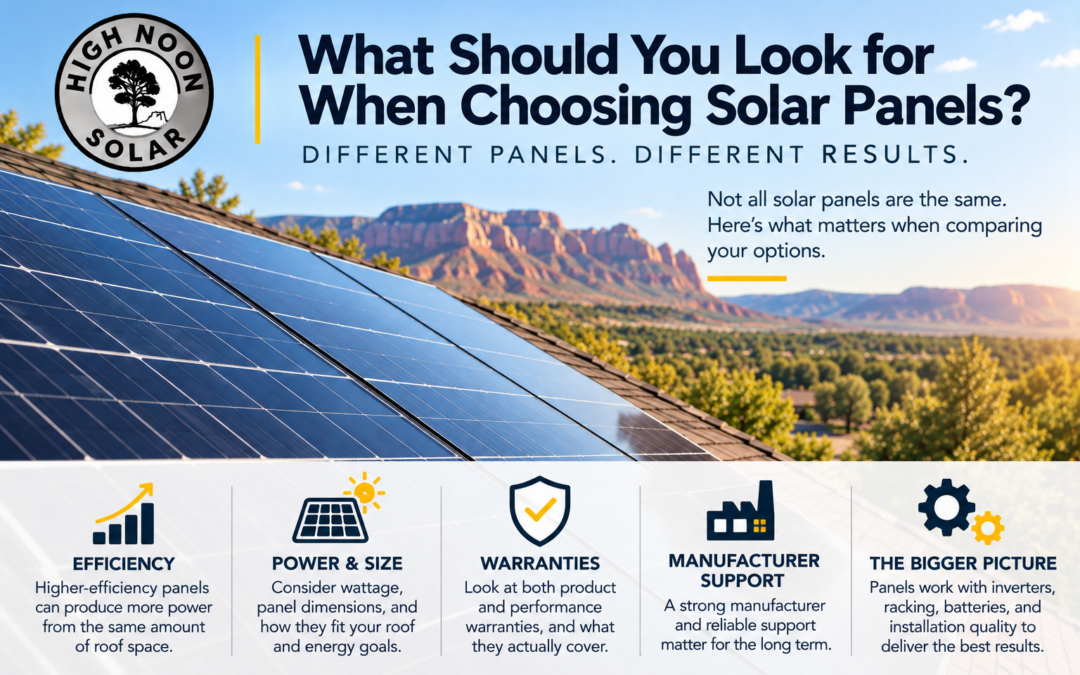
Not all solar panels are the same, and the highest wattage or lowest price does not automatically make one panel the best choice.
A good solar panel should be evaluated as part of the entire system, including how it will perform on your property, how well it is supported by the manufacturer, and how it fits with the rest of the equipment being installed.
Panel Efficiency
Solar panel efficiency tells you how effectively a panel converts sunlight into electricity.
Higher-efficiency panels can produce more power from the same amount of roof space, which can be useful when space is limited. But efficiency is only one factor to consider. A slightly lower-efficiency panel may still be a good fit depending on the system design, available space, cost, and overall project goals.
Power Output and Panel Size
Panel wattage tells you how much power a module is rated to produce under standard test conditions.
Higher-wattage panels can reduce the total number of modules needed for a system, but physical size matters too. A larger panel may not fit a roof layout as well as a slightly smaller one.
That is why system design should consider both wattage and dimensions rather than looking at wattage alone.
Degradation and Long-Term Performance
Solar panels gradually produce a little less electricity as they age.
Manufacturers typically publish a performance warranty that explains how much output the panel is expected to retain over time. The degradation rate can vary by manufacturer and model, so it is worth reviewing the actual warranty instead of assuming every panel performs the same way.
Learn more about how long residential solar panels last.
Product and Performance Warranties
Solar panels may include more than one type of warranty.
A product warranty generally covers defects in the panel itself, while a performance warranty addresses how much power the panel is expected to produce over time.
Warranty length matters, but so does what the warranty actually covers and how easy it is to get support if something goes wrong.
Manufacturer Support
A long warranty is only valuable if the manufacturer can support it.
When comparing panels, it is worth considering the manufacturer’s history, service network, warranty process, and availability of replacement equipment.
Installer support matters too. Having a local company that can help diagnose a problem or work through a warranty claim can make a big difference years after the original installation.
Compatibility With the Rest of the System
Solar panels do not operate by themselves.
They need to work properly with the inverter, racking, electrical equipment, monitoring system, and any battery storage that may be included now or added later.
The best panel for one property may not be the best choice for another.
Look at the Whole System
Choosing solar equipment should not come down to one specification.
Efficiency, wattage, size, degradation, warranties, manufacturer support, system compatibility, installation quality, and long-term service should all be considered together.
High Noon Solar evaluates the equipment as part of the complete system so the final design fits the property and the customer’s goals.